

Most cold plunge water problems are not chemistry problems. They are mold problems.
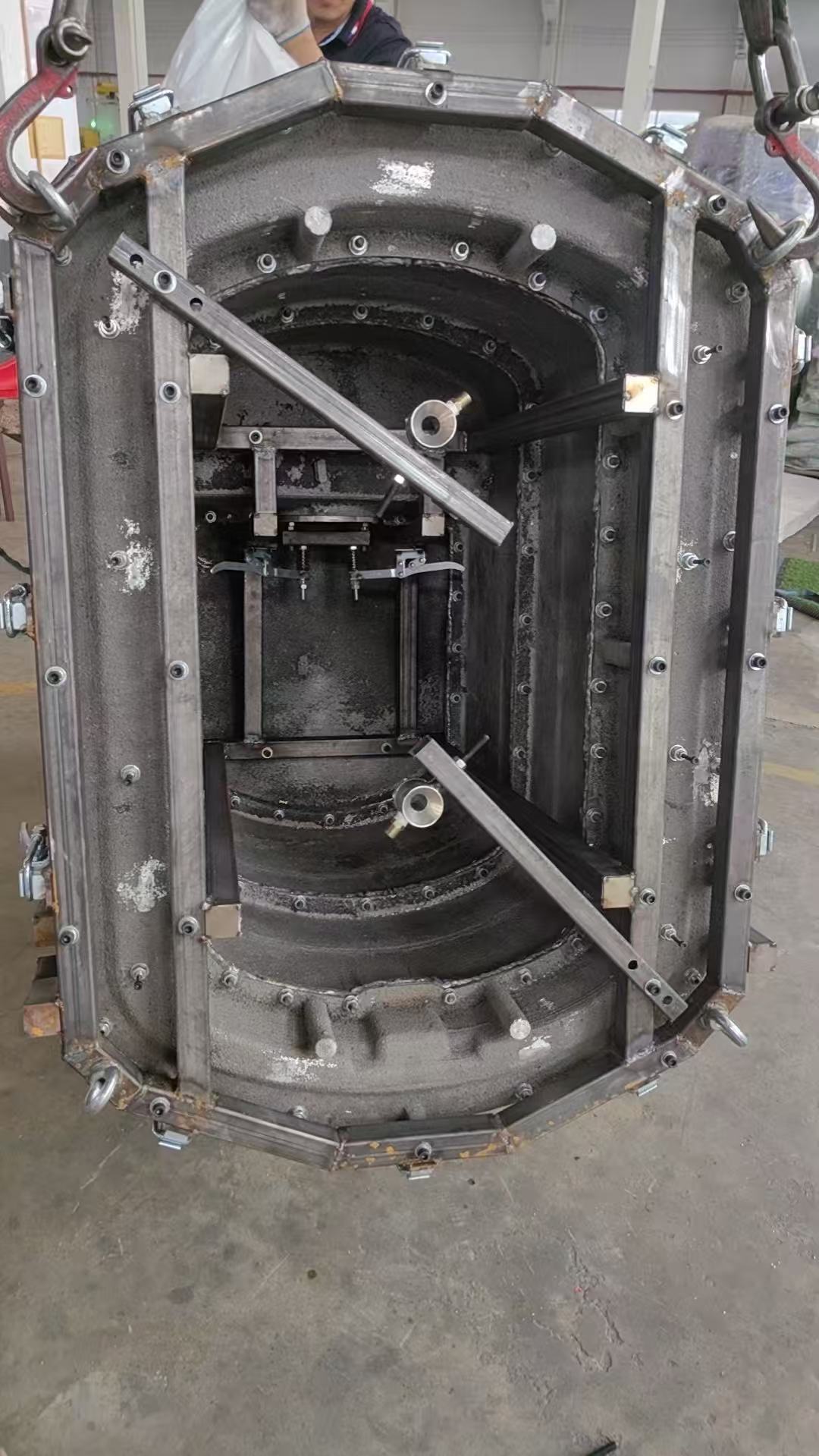
In a rotomolded tub, the skimmer pocket, the floor slope, the return port and the equipment bay are fixed when the mold is cut — not when the pump is installed. If the tool leaves a flat floor and one high return, no ozone generator will clear the dead water that settles under the seat. We have seen both extremes from the same 700 L class of tub: one holding clear water on three turnovers a day, another clouding up at eight.
This guide covers what actually determines water quality in a commercial rotomolded cold plunge, how the four common sanitizer routes behave inside an HDPE shell, and the maintenance schedule we hand to operators at handover.
1. Water treatment starts in the mold
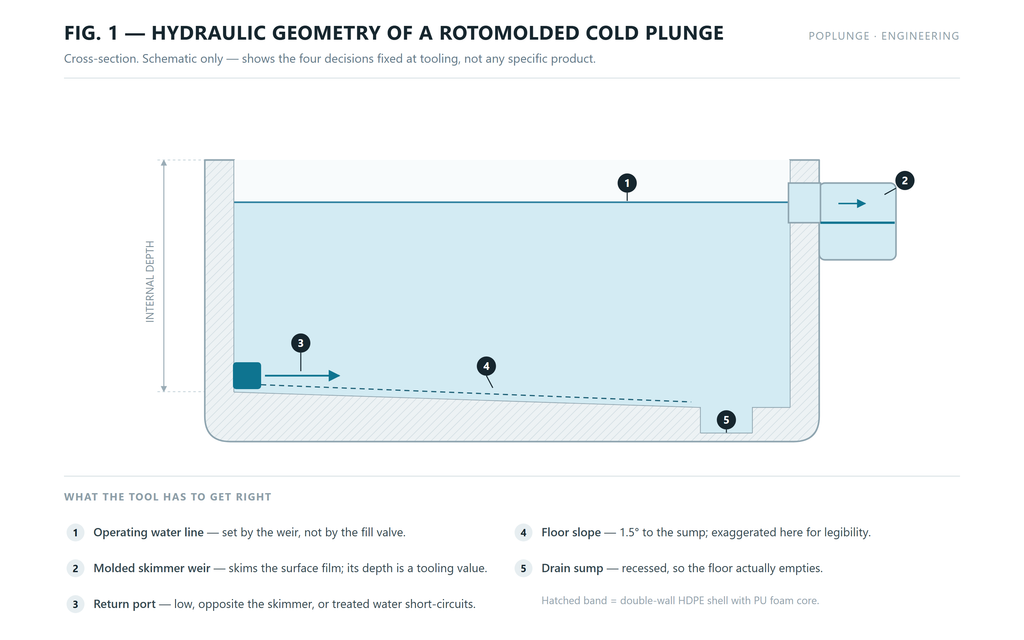
Four tooling decisions determine whether a tub can be kept clean at all.
Skimmer weir location and depth. The weir sets the operating water line and skims the surface film where oils and sunscreen collect. On a rotomolded shell it is a molded pocket, so its depth is a tooling value. Too shallow and the surface never clears; too deep and the pump draws air.
Floor slope and drain pocket. Specify 1–2° toward a recessed sump. A flat molded floor leaves a 5–10 mm layer that never joins the circulation loop, and that layer is where biofilm starts.
Return port placement. A single return high on one wall creates a short circuit: treated water crosses the surface and exits the skimmer without ever reaching the far end. The return should sit low and opposite the skimmer. If the mold gives you only one port, plan a second one before tooling, not after.
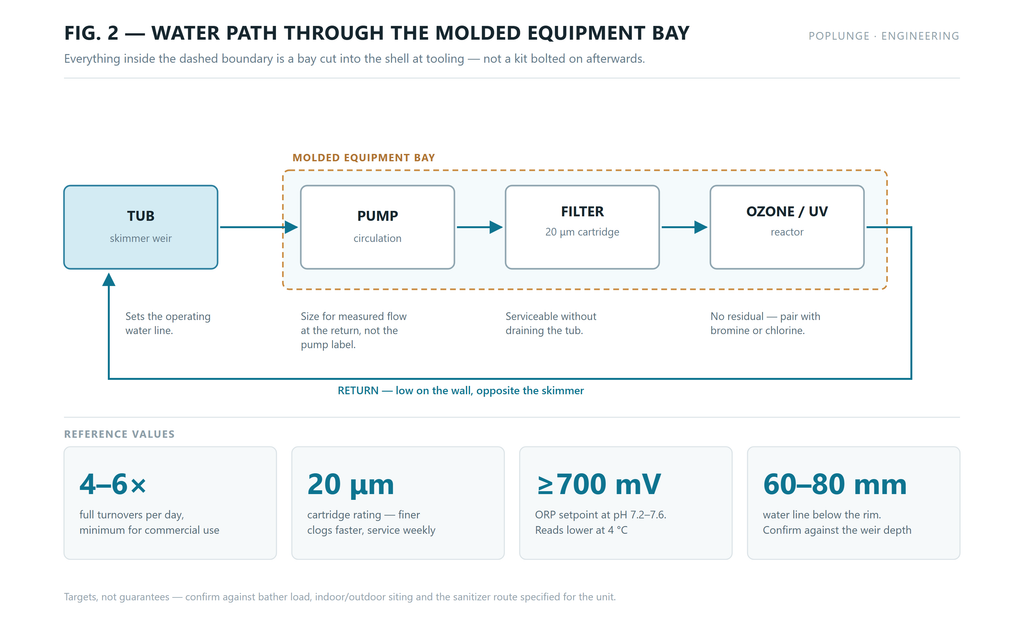
Equipment bay dimensions. Pump, cartridge filter, ozone generator and UV housing all live in that bay. Cutting the bay for a pump alone means the filter ends up external, in a shed, plumbed with 3 m of flex hose — which is where most turnover is lost.
2. HDPE behaves differently from acrylic — use it
High-density polyethylene is non-porous and chemically inert. It does not craze under sustained chlorine or bromine exposure the way an acrylic shell or a gelcoated surface can, and it will not delaminate. For a commercial operator running 700–750 mV ORP all day, that tolerance is the main structural advantage of a rotomolded shell over an acrylic one.
Two caveats belong in the specification, not the brochure.
Surface texture. Rotomolded parts carry the mold’s finish. A coarse texture raises the effective surface area available to biofilm and makes brushing less effective. Specify the finish and the corresponding Ra value, and tell operators to use a soft brush only — abrasives on HDPE leave scratch fields that are far harder to clean than the original texture.
Colour and solar gain. A dark shell in direct sun absorbs heat. Warmer water consumes sanitizer faster, so an outdoor black tub and an indoor white tub of the same volume do not share a dosing schedule. If the unit is going outdoors, plan for a cover, and size the chiller for the solar load rather than the ambient air temperature alone.
3. The four sanitizer routes
| Route | Kill speed | Residual | Notes in an HDPE tub | Best fit |
|---|---|---|---|---|
| Chlorine | Fast | Yes | Fully compatible with HDPE. Degrades faster at low pH and under UV; needs daily testing | High-traffic commercial, tight budget |
| Bromine | Medium | Yes | Effective over a wider pH band. Gentler on stainless fittings than chlorine at temperature | Hospitality, spas, lower-odour environments |
| Ozone (O₃) | Very fast | No | HDPE and PTFE are highly resistant; EPDM and natural rubber seals are not — specify ozone-compatible seals and PTFE-lined fittings | Secondary oxidation alongside a residual sanitizer |
| UV-C (254 nm) | Fast, in-line only | No | No chemical exposure. Performance depends entirely on quartz sleeve cleanliness and dose | Paired with chlorine or bromine for residual |
Two engineering points matter more than the choice itself.
Ozone and UV leave no residual. Water that has passed the reactor is clean; water sitting in the tub is not. Every ozone or UV installation still needs a residual sanitizer, even at low dose.
Ozone attacks elastomers, not the shell. The failure we see is not a degraded HDPE wall — it is a swollen EPDM O-ring at the return fitting eighteen months in. If the unit runs ozone, the seal specification is part of the water treatment design.
4. Turnover and hydraulics
Turnover rate, not sanitizer dose, is the usual root cause of cloudy water.
For a commercial unit with regular foot traffic, plan for four to six full turnovers per day as a floor, and run circulation continuously rather than on a timer. A 700 L tub at four turnovers needs roughly 2 m³/h of actual flow through the filter — measured at the return, not on the pump label, because cartridge restriction and hose length both eat into it.
Filter selection follows from that. A 20 μm cartridge is the practical default; 5 μm removes more but loads faster and needs weekly rather than fortnightly service. Whatever the rating, the cartridge must be reachable without draining the tub — which brings the conversation back to the equipment bay.
5. Cold water changes the numbers
At 3–5 °C, disinfection kinetics slow down considerably. Contact time needs to go up, and a dose that holds 750 mV at 25 °C will not hold it at 4 °C. Two practical consequences:
- Do not read ORP the same way as in a warm pool. ORP probes read lower in cold water for the same chemical condition. Operators who chase the number upward end up over-dosing.
- “It’s cold so it’s clean” is false. Low temperature slows bacterial growth, but it also slows the sanitizer. The net effect is not protection.
6. The maintenance schedule
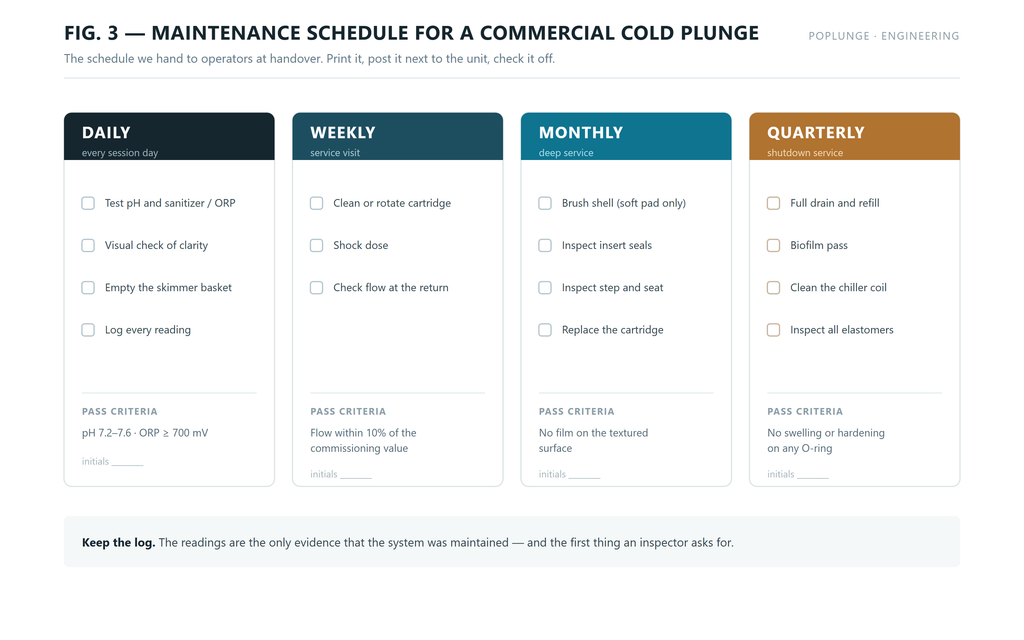
| Frequency | Task | Pass criteria |
|---|---|---|
| Daily | Test pH and sanitizer/ORP; visual check; empty skimmer basket; log readings | pH 7.2–7.6, ORP ≥ 700 mV |
| Weekly | Clean or rotate cartridge; shock dose; check flow at return | Flow within 10% of commissioning value |
| Monthly | Brush shell with soft pad, including molded step and seat cavities; inspect inserts and seals; replace cartridge | No visible film on textured areas |
| Quarterly | Full drain and refill; biofilm pass; clean chiller coil; inspect O-rings at all fittings | No swelling or hardening on elastomers |
The log is not paperwork. It is the only evidence an operator has that the system was maintained, and it is the first thing an inspector asks for.
7. Six questions to ask any supplier
- What is the measured flow at the return, not the rated pump flow?
- Where is the skimmer weir, and what water line does it set?
- Is there a floor slope to a drain sump, and what is the angle?
- Can the cartridge be changed without draining the tub?
- Are the seals and O-rings specified for ozone service?
- What is the chiller coil material, and is it compatible with the sanitizer we plan to run?
If a supplier cannot answer the first three from the drawing, the tub will be maintained by guesswork.
At Poplunge, we cut the skimmer pocket, floor slope and equipment bay into the mold at the tooling stage, because those are the decisions that determine whether a commercial tub can be kept clean. If you are specifying a rotomolded plunge for a facility or a private label, send us the operating conditions [blocked] — bather load, indoor or outdoor, sanitizer preference — and we will confirm the tooling configuration before a mold is cut.