

Piscine Global Europe 2026 · Eurexpo Lyon · November 17–20
Piscine Global Europe 2026 ran November 17–20 at Eurexpo Lyon. It is a biennial show — close to 1,000 exhibitors and brands from more than 33 countries in 2026, with the 2024 edition drawing roughly 24,000 industry professionals from 113 countries.
We did not take a stand this year. Our partner team walked the floor for four days, and they came back with the same question we answer every week: how do you tell a good rotomolded cold plunge tub from a good-looking one?
This is not a trend report. It is an audit checklist — six decisions that are settled at the mold, before a single tub is produced, and that no purchase-order clause can fix afterwards.
1. At Three Metres, a Tub Gives Itself Away
On a trade-show floor you cannot measure anything. But four features are readable from the aisle, and they tell you how the shell was made before anyone opens a spec sheet.
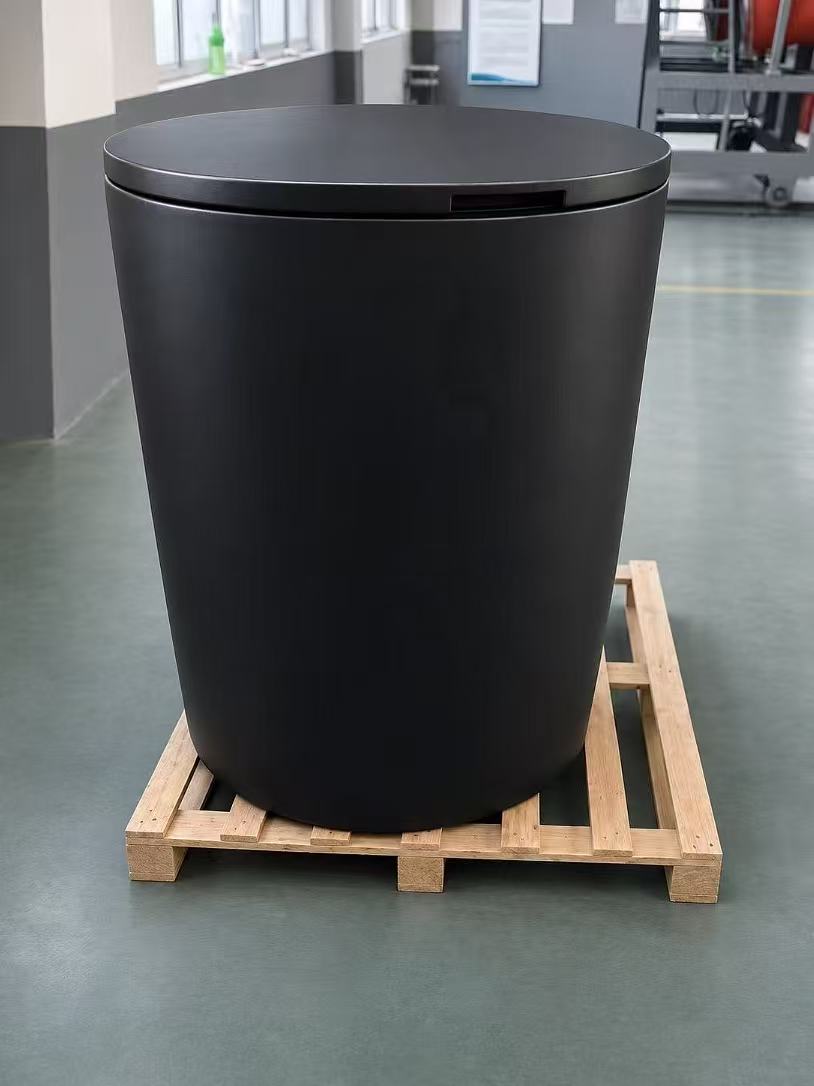
The rim. A rotomolded tub forms its rim in the mold, so the top edge is one continuous closed section — the double wall is visible as a finished edge. A thermoformed acrylic tub has to meet a structural backing, which means a cap, a trim line, or a visible joint at the rim. A stainless tub shows a rolled or welded edge, and the quality of the weld dressing tells you about the workshop.
The inside corners. Rotomolding cannot produce sharp internal corners. Radii are generous, and they should look identical on every unit on the stand. Corners that are tight and crisp usually mean thermoforming, or a bonded insert hiding a joint.
The base and the parting line. Look for a molded-in recessed base or molded feet rather than a bolted-on plinth, and for a horizontal parting line. How heavily that line has been hand-dressed is a fair proxy for mold age and maintenance discipline.
The equipment bay. Is it molded into the shell, or a box bolted on afterwards? A bolt-on bay means more fasteners, more potential leak paths, and a break in the insulation where it matters most.
What to do: ignore the three-quarter hero shot. Ask to see the rim, the inside corner, the base, and the bay — in that order.
2. Shell Cost Hides Where Buyers Don’t Look
Wall thickness is set by the powder charge, not by the mold cavity. Polymer flows and coats the tool, ending up thicker where the tool is deep and thinner across large flats and near the rim. That means wall thickness is not a number — it is a distribution, and any supplier who quotes a single figure is quoting a drawing rather than a part.
We mold to a nominal 5 mm shell, and we verify it with a measurement report taken at five marked points: base, seat, footwell, rim, and equipment-bay wall. That report is what a buyer should be asking for, from any supplier, before a purchase order.
The parting line is diagnostic. It is cosmetic, but it is also a record. A heavily dressed parting line on a large tub usually means an old tool being kept alive with hand work.
Inserts are what you are actually buying. A commercial tub gets serviced for years. Molded-in metal threaded inserts accept repeated disassembly; self-tapping screws driven into a 5 mm wall do not. The difference shows up in year three, on site, in front of your customer.
3. Insulation Is a Mold Decision, Not an Option
On a double-wall tub, the insulation lives in the cavity between the two shells. That cavity’s geometry comes from the mold, and how completely it gets filled comes from the process. Neither can be added later.
The failure mode is voids — at the corners, around the equipment bay, and under the seat. A void is a thermal bridge, and a thermal bridge is a bill your customer’s chiller pays every day for years. This is the single most expensive thing that can be wrong with a tub and the least visible thing on a spec sheet.
“High-density foam” is a marketing phrase, not a specification. Ask for the density in kg/m³, the fill method, and — most revealingly — whether the supplier will section a rejected part and show you the cut face. A supplier who will not cut a part in half is telling you something about the inside of that part.
The lid belongs in this section too. A loose, uninsulated lid defeats good walls faster than any other single component.
4. The Equipment Bay Sets Your Install Labor
A molded-in bay and a bolted-on sheet-metal box look similar in a photograph and behave nothing alike on site. The molded-in version has fewer fasteners, fewer leak paths, continuous insulation, and a service clearance that is the same on every unit you ship.
For a pool builder or a hotel contractor, this is the difference between one crew-day and three trades on site. Plumbers quote by the day, electricians quote by the visit, and neither is interested in a tub that needs a site meeting.
What to ask: internal bay dimensions, service clearance on at least one full side, whether the plumbing is pressure-tested before crating, how many power feeds the unit needs, and whether the site-preparation drawing reaches you before the purchase order rather than after.
Bay dimensions also constrain chiller selection, so this is a decision that reaches beyond the shell.
→ Related: How to Pair the Right Chiller with Your Rotomolded Cold Plunge: A B2B Engineering Guide
5. Nesting Is Locked on Mold Day
Nesting is a mold decision. The shell taper and the rim geometry determine how far one tub sinks into the next, and therefore how many units fit into a container. Our current production models nest up to 56 units per 40GP.
Un-nested, the same container holds a fraction of that — you are paying freight for air, on every shipment, for the life of the product. On a 40GP, the difference between a nested and an un-nested load moves your landed cost per unit further than a few points of FOB negotiation will.
And you cannot retrofit it. If the mold was built without taper, you buy air for as long as you sell the tub.
What to ask: units per 40GP nested versus un-nested, packed volume per unit, whether lids ship inside the nest or as a separate line, whether chillers are consolidated into the same container, the HS code, and the Incoterms you are actually being quoted on.
A quiet test: ask for the container loading plan. A supplier who has one will send it in an hour. A supplier who does not has never modelled their own freight — which means neither have you.
If you want the loading plan for your model, ask for it — we will send the container layout drawing with the quotation.
6. Color, Texture and UV Are Material and Tool Decisions
Color comes from masterbatch. UV performance comes from the stabiliser package. Texture comes from the mold surface. All three are fixed before production starts, and all three are things buyers negotiate at the wrong moment — after they have fallen in love with a sample.
In Europe, the failure mode is not breakage. It is fade and chalking after two outdoor seasons, and that lands as a warranty claim against your brand, not against your supplier.
What to ask: the UV stabiliser package and the expected outdoor service life, whether color is matched to a physical sample or to a Pantone reference (they are not the same promise), the color MOQ per run, whether the texture comes from the existing tool or requires a new one, who owns the tool, who pays for its maintenance, and whether you get exclusivity on it.
→ Related: Rotomolded vs. Acrylic vs. Inflatable PVC Cold Plunges: A Complete B2B Buyer’s Guide · OEM/ODM Guide: How to Launch Your Own Custom Cold Plunge Brand
The audit, on one page
| Decision | Ask for | Red flag |
|---|---|---|
| Shell construction | Rim detail, inside corner radius, base, whether the bay is molded in | Hero shots only, no rim or base images |
| Wall thickness | Measurement report at five points, not a single figure | “5 mm” quoted with no report attached |
| Insulation | Foam density in kg/m³, fill method, a section cut of a part | “High-density foam” with no number |
| Install labor | Bay dimensions, service clearance, pressure test before crating, site-prep drawing | Drawing arrives after the PO |
| Landed cost | Units per 40GP nested vs un-nested, container loading plan, Incoterms | Volume quoted per unit, no packing data |
| Brand differentiation | UV package, sample match, color MOQ, tool ownership and exclusivity | “Any color” with no mold cost stated |
Send eight fields, get a quotation in 12–24 hours
Most sourcing conversations lose two weeks to questions that could have been answered in the first email. Send these and we can quote properly on the first reply:
- Target market and compliance regime (EU, UK, US, AU)
- Application — hotel, gym, recovery studio, residence, distributor stock
- First-order volume and 12-month outlook
- Shell format — vertical, reclined, compact, or stainless-clad
- Chiller — supplied by you, or to be paired by us
- Water treatment preference — ozone, UV, or bromine
- Branding — logo method, target color, expected MOQ
- Destination port and Incoterms
Who we are a fit for: distributors and brands placing repeat container orders, hotel and spa projects, and gym or recovery-studio chains specifying a standard unit across sites.
Who we are not a fit for: single-unit retail purchases, and buyers who need a finished consumer product shipped directly to end users. We build the hardware and the tooling; we do not run your storefront.
Send your specification → · sales@poplunge.com
FAQ
What wall thickness should a rotomolded cold plunge tub have?
A commercial tub is typically molded to a nominal 5 mm shell, but thickness varies across the part because it is set by the powder charge rather than the mold cavity. Ask for a measurement report at several marked points — base, seat, footwell, rim and equipment-bay wall — rather than accepting a single quoted figure.
How many cold plunge tubs fit in a 40GP container?
It depends on the shell taper and the rim geometry. Our current production models nest up to 56 units per 40GP in nested packing. Always ask for the container loading plan alongside the quotation, and confirm whether lids ship inside the nest or as a separate line.
Why does nesting matter to my landed cost?
Freight is charged on the container, not on the unit. A tub that nests lets far more units share the same container, so the freight cost allocated to each unit falls. Because nesting is determined by the mold, it is one of the few cost drivers a buyer can evaluate before placing an order — and one of the few that cannot be changed afterwards.
Is Piscine Global Europe held every year?
No. It is a biennial show, held in even years at Eurexpo Lyon in France. The next edition is expected in 2028, which means the 2026 show set the specification cycle running through 2027.